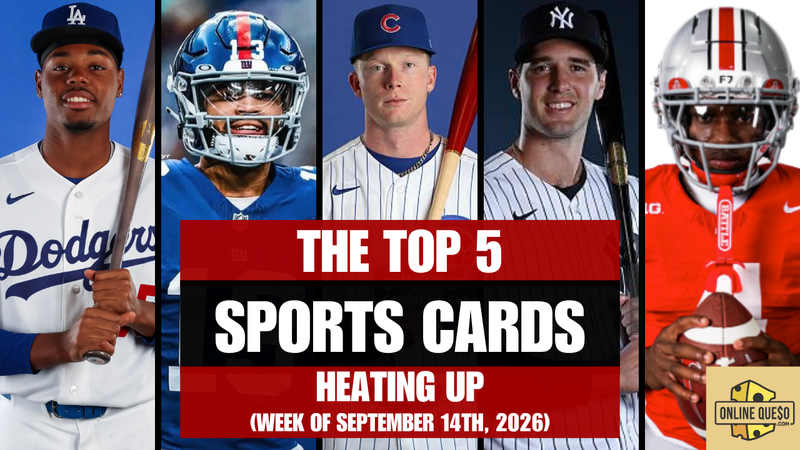
A video counting down the most valuable baseball cards from the early 1990s came across my feed this week, and the prices attached to them were big enough that I went and looked up the actual numbers. Some of them checked out. A few were a little off. The ones that were right are strange in a way worth explaining, because most baseball cards from that era are worth almost nothing, and a small handful are worth a house.
That gap is the whole story. If you had a shoebox of cards from 1990 to 1995 in a closet, the honest answer is that the box is probably worth about what a large pizza costs. The exceptions are so specific, and so tied to condition, that they are worth understanding one at a time.
The short version
The five most valuable baseball cards from the early 1990s, ranked, are the 1993 SP Derek Jeter rookie, the 1992 Bowman Mariano Rivera rookie, the 1991 Studio Jeff Bagwell rookie, the 1994 Upper Deck Michael Jordan, and the 1992 Fleer Update Mike Piazza rookie. In top grade, they run from roughly $400 on the low end to more than $200,000 for the Jeter, with a record Jeter sale of $600,000.
For anyone digging through an old collection, this is what matters. Every one of these cards can be bought raw, ungraded, for pocket change or close to it. The value lives almost entirely in the PSA 10 grade, and PSA 10s are scarce because these cards were mass-produced and are murder to keep perfectly centered with clean edges. You are not paying for a rare card. You are paying for a common card that survived in flawless condition.
Why are most early 1990s baseball cards worthless?
Most early 1990s baseball cards are worthless because the companies printed a staggering number of them. Collectors call this stretch the junk wax era for a reason. Everyone who lived through the late 1980s baseball boom kept buying, the manufacturers kept the presses running, and the market drowned in supply that still has not dried up thirty years later.
The result is that a 1991 or 1992 base card of almost any player, in the condition it came out of the pack, is worth a few cents. Complete sets sell for a few dollars. If you want the longer version of how this happened, and which junk wax cards actually surprise people, we wrote about the hidden gems of the junk wax era and the most iconic baseball cards from the junk wax era separately.
What makes a junk wax era card actually valuable?
In the junk wax era, value comes almost entirely from condition, not from the card being rare. When a card was printed by the millions, the only way to create scarcity is to demand perfection. A PSA 10, the top grade on a ten-point scale, requires sharp corners, clean edges, perfect centering, and no print flaws. On cards that were cut fast and stacked into boxes by the truckload, that combination is genuinely hard to find.
That is why a card you can hold in your hand for a dollar becomes a several-hundred-dollar card the moment it earns a 10. You are buying the survivor. Keep that idea in mind for the whole list, because it explains every number below.
5. Mike Piazza, 1992 Fleer Update (PSA 10 around $400)

The most valuable Mike Piazza card from this era is his 1992 Fleer Update rookie card, card number U-92, with PSA 10 copies selling in the $400 to $460 range in 2026. The reel I watched put it at $365, which is a little light now, so call it roughly $400 as a fair mark.
What makes this one interesting is that the 1992 Fleer Update set was printed in smaller quantities than a typical update set of the period, because wholesale demand was weak after a soft prior year, so Fleer produced closer to order. That gives it a touch of real scarcity on top of the usual condition problem, which is unusual for the junk wax era. Piazza went on to a Hall of Fame career as the best hitting catcher the game has seen, and this is the card that tracks it from the beginning.
4. Michael Jordan, 1994 Upper Deck (PSA 10 over $500)

Yes, a Michael Jordan baseball card belongs on this list. During his break from the NBA, Jordan played minor league baseball in the Chicago White Sox system, and his 1994 Upper Deck card number 19 captures it. PSA 10 copies sell for well over $500, and clean examples have pushed into four figures because the dark borders show every speck of wear, which makes a true 10 hard to come by. Raw, you can still buy the card for ten or fifteen dollars.
One honest correction to the countdown I watched. It called this his most valuable baseball card from the era, and that is not quite right. His 1991 Upper Deck short print, card SP1, sells for more, around $1,500 in a PSA 10. The 1994 Upper Deck number 19 is the most famous and most recognizable Jordan baseball card, which is a different claim than most valuable. Both things can be true, and the card is a fun piece of crossover history either way.
3. Jeff Bagwell, 1991 Studio (PSA 10 around $600)

The Jeff Bagwell 1991 Studio rookie, card number 172, is the quiet surprise of this group, with PSA 10 copies typically selling in the mid-hundreds and recent sales ranging from about $460 up past $1,000. Raw, it is a one-dollar card. You could probably find it in any junk wax box in America.
The jump comes down to the population. The PSA 10 population is tiny, only around thirty copies, which works out to about a five percent gem rate against a set average closer to twenty-five percent. The 1991 Studio cards were prone to condition issues, so almost nobody has a perfect one, and the ones who do can name their price. This is the clearest example on the list of value coming from pop count rather than from the card itself being scarce. Bagwell is in the Hall of Fame, which gives the card a permanent floor of demand.
2. Mariano Rivera, 1992 Bowman (PSA 10 around $677)

The 1992 Bowman Mariano Rivera rookie, card number 302, is his only true mainstream rookie card, and PSA 10 copies sell for around $677. Raw, it runs closer to $60 or $75, which is high for a junk wax era card and tells you how much demand there is for the greatest closer in baseball history.
The catch here is different from the Bagwell. The PSA 10 population on this card is high, well over a thousand copies, so the 10 is not scarce the way Bagwell's is. The price holds up on Rivera's name alone: five World Series titles and the only unanimous Hall of Fame selection ever. When a player is that beloved, even a card that graded well thousands of times keeps a strong number.
1. Derek Jeter, 1993 SP (PSA 10 over $200,000)

The most valuable baseball card from the early 1990s, and arguably the most valuable baseball card of the entire decade, is the 1993 SP Derek Jeter rookie, the foil card numbered 279. PSA 10 copies sell for well over $200,000, with a Card Ladder high of $324,000 recorded in July 2026, and the all time record sale sits at $600,000 for a PSA 10 back in May 2022, per Old Sports Cards. You can see the full grading breakdown on PSA's card facts page.
Everything about this card is condition sensitive. The 1993 SP set used a foil finish that chips and shows edge wear at the slightest handling, so a flawless copy is close to a miracle. The PSA 10 population is around twenty-two. That is why even a PSA 9, one grade down, sells for roughly $8,000 today. Raw, you can still buy an ungraded Jeter for somewhere around $130 to $200, which is the same pattern as every other card on this list taken to its extreme. A cheap common card, in perfect shape, becomes one of the most expensive baseball cards ever made.
What the countdown left out
Two early 1990s cards belong in any honest most valuable conversation and did not make the video. The first is the 1991 Topps Desert Shield Chipper Jones rookie, card number 333, which is genuinely rare because Topps sent that parallel to United States troops stationed in the Gulf during Operation Desert Shield, so very few survived. PSA 10 copies routinely sell in the $8,000 to $15,000 range and up.
The second is the 1990 Topps Frank Thomas card number 414 with no name on the front, a famous printing error where his name plate was left blank. The error is genuinely scarce in top grade, where the single PSA 10 copy has sold for more than $180,000. Lower grade copies still bring mid-four figures, while the corrected common version is a few dollars. Both are reminders that in this era, a true production quirk is one of the only things that can beat pure condition scarcity.
How do I find out what my early 1990s baseball cards are worth?
To find out what your early 1990s baseball cards are worth, look up recent sold prices rather than asking prices, and check the exact card and grade. Search the card by year, set, player, and card number on eBay, then filter to sold listings so you see what people actually paid, not what sellers are hoping for. For graded values, sites like Card Ladder and Sports Card Investor track PSA sales over time.
The honest expectation is that the vast majority of a junk wax era collection is worth its sentimental value and little more. The way you win is by finding the one card that is both a desirable player and a candidate for a high grade. If a card looks perfectly centered with sharp corners and clean edges, and it is a star or a Hall of Famer, that is the one worth the cost of grading. Everything else is better enjoyed than appraised. A lot of these cards now change hands on live selling platforms too, which is part of why we looked at Whatnot's rise in live commerce.
Frequently asked questions
What is the most valuable baseball card from the early 1990s?
The most valuable baseball card from the early 1990s is the 1993 SP Derek Jeter rookie, foil card number 279. PSA 10 copies sell for well over $200,000, and the record sale is $600,000 for a PSA 10 in May 2022.
Are early 1990s baseball cards worth anything?
Most early 1990s baseball cards are worth very little because they were mass-produced during the junk wax era. The valuable exceptions are top rookies and stars in a perfect PSA 10 grade, which is scarce because these cards are hard to find flawlessly centered and edged.
Why is the 1993 SP Derek Jeter rookie so expensive?
The 1993 SP Jeter is expensive because it is the flagship rookie of a first-ballot Hall of Famer, printed on a foil stock that chips and wears easily. That makes a PSA 10 extremely rare, with a population of around twenty-two, so collectors pay six figures for a perfect copy.
What is the junk wax era in baseball cards?
The junk wax era refers to roughly 1987 to 1994, when card companies printed enormous quantities of cards to meet a boom in demand. The oversupply means most cards from that period have almost no value today, regardless of the player.
How do I know if my old baseball cards are valuable?
Check recent sold listings on eBay for the exact card, year, set, and number, and note the grade. Value in this era is driven by condition, so a common card in flawless shape can be worth far more graded than raw. Star players and Hall of Famers in high grades are the ones worth grading.
Interested in learning more?
If you want to keep going down the cardboard rabbit hole, here are a few more from the blog:
Final Thoughts
The reason a countdown like this is fun is also the reason it is a little cruel. The cards that made me want to look up the numbers are worth thousands or more, and the version of them sitting in most people's closets is worth a dollar, because the only thing separating the two is a grade almost no copy earns. That is the real lesson of early 1990s baseball cards. The player gets you interested, the pop count sets the price, and condition decides everything.
If you have a box of these somewhere, it is worth ten minutes to pull the stars and the Hall of Famers and really look at the corners and centering. Most of them will be exactly what you expect. Every so often, one is the survivor.